
India’s real estate market has never been more active than it is right now, driven by a massive shift toward modern urban living and a surge in high-quality commercial infrastructure across tier-1 and tier-2 cities.
If you are someone planning to buy a property or a seasoned investor trying to diversify your portfolio, one question always comes up: Should you put your money into a home or in a business property?
There is no specific answer to this question, as the decision of purchasing residential vs commercial real estate largely depends on your investment goals and the purpose behind the purchase.
In this blog, we will break down the key differences between the two and help you understand which type of real estate investment may be the right fit for your goals.
Understanding Residential Real Estate
Purchasing residential real estate requires understanding current market trends, advantages, risks, and challenges. So, let’s get into it:
What is Residential Real Estate?
Residential real estate is property meant for people to live in. This includes apartments, independent houses, villas, and residential plots. These properties are zoned for residential purposes only.
Current Trends in Residential Real Estate (2026)
The demand for residential properties has stayed strong through 2026. Tier 2 city like Ajmer is seeing an accelerated growth, driven by infrastructure development, better road connectivity, and a clear shift of buyers away from congested metros. Not only this, the government launched schemes like PMAY (Pradhan Mantri Awas Yojana), which added further boom to the overall residential market.
Advantages of Residential Property Investment
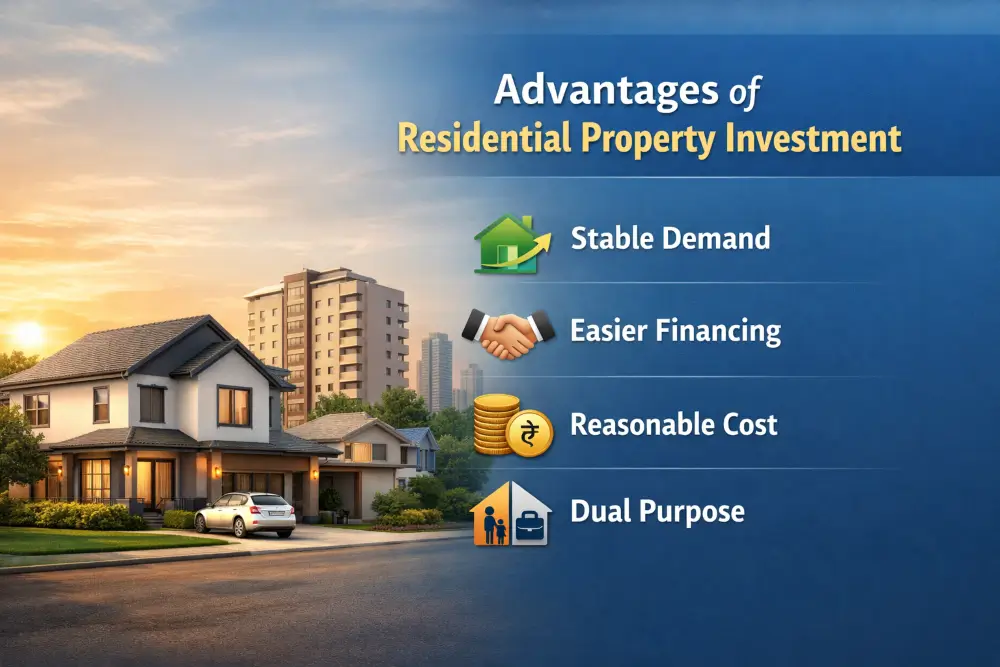
- Stable demand: Residential property demand rarely crashes, even during economic slowdowns, because people always need a place to live.
- Easier financing: You can access home loans easily at lower interest rates compared to commercial loans.
- Reasonable cost: Especially in tier 2 cities, you can start your real estate investment journey at a reasonable cost.
- Dual purpose: Your investment in residential property works both as a personal asset and a long-term wealth creator.
Risks & Challenges
The physical risks in residential property include structural defects in your property, delays in possession, and construction quality concerns in under-construction projects. Some major challenges include budget constraints due to additional charges on property prices, such as registration fees, stamp duty & GST; the need to conduct complex legal verification of the land; and ensuring that the developer has obtained the necessary occupancy and completion certificates to avoid future litigation or utility issues.
But if you choose the right developer to purchase a residential property, you won’t have to go through all this hassle; they will assist you with everything from selecting the right property to your safe possession.
Understanding Commercial Real Estate
Read more: Benefits of Buying Independent Plots for Families

Purchasing commercial real estate involves understanding its current trends, advantages, risks, and challenges. So, let’s get into it:
What is Commercial Real Estate?
Commercial real estate refers to properties used for business, industrial, or income-generating purposes. This includes office spaces, retail shops, warehouses, and industrial units. These properties are leased to businesses, with rental income as the primary source of return.
Commercial Real Estate Trends in 2026
India’s commercial real estate market is bouncing back strongly. Co-working spaces are expanding well beyond metro cities. Warehousing and logistics parks are booming amid e-commerce growth, and office developments continue to attract investors.
Even in smaller cities, commercial spaces near highways, industrial corridors, and Smart City zones are attracting investors.
Advantages of Commercial Property Investment
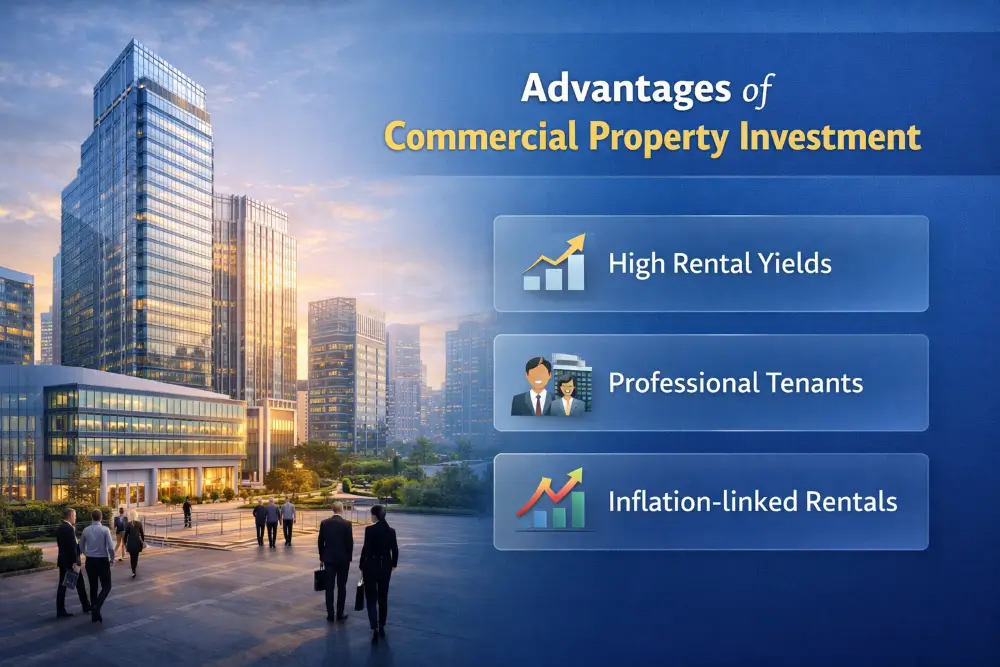
- High Rental Yields: You can realistically expect 6-9% returns, significantly higher than residential.
- Professional Tenants: You will usually deal with businesses, which means longer lease periods of around 3-5 years.
- Inflation-linked rentals: Most commercial leases include periodic escalation clauses, so your income keeps pace with inflation.
Risks & Challenges
One of the common risks in Residential vs Commercial Real Estate (especially commercial real estate) is its strong connection to the economy. When businesses do not get enough profits, they may shut down completely, which can lead to your building or shop sitting empty. This vacancy rate is especially common for properties in secondary locations.
Additionally, in Residential vs Commercial Real Estate, commercial property comes with a bigger financial challenge. It often requires a high down payment, sometimes up to 25–30% of the total price, along with stricter loan approval rules compared to residential properties.
Residential vs Commercial Real Estate: Key Comparison (2026)
There are a few key comparisons of residential vs commercial real estate, which you can understand with the help of this table:
| Feature | Residential Real Estate | Commercial Real Estate |
| Initial Investment | Lower to Mid-range | High |
| Rental Yield | 2% – 3.5% | 6% – 9% |
| Lease Duration | Short (11 months typical) | Long (3 – 10 years) |
| Maintenance | Paid by Owner | Often paid by Tenant |
| Risk Factor | Low to Moderate | Moderate to High |
Which is Growing Faster in 2026?
There is no perfect answer to this, because both Residential vs Commercial Real Estate are growing in different ways. If we talk about residential real estate, then it is growing more broadly, especially across tier 2 cities, due to increasing urbanization. On the other hand, commercial real estate is also growing faster in terms of rental yields and investment, but primarily in established business corridors and tier 1 & tier 2 cities.
For most buyers purchasing property in a tier 2 city like Ajmer, Residential vs Commercial Real Estate comparison clearly shows that residential real estate remains the most practical and reliable growth opportunity this year. For experienced investors with larger capital, commercial real estate in the right locations offers excellent yield potential.
Who Should Invest in Residential Property?
- First-time buyers: If you want to own a home while also building long-term wealth, then residential property is the right pick for you.
- NRIs: If you are looking for a stable, appreciating asset back home with minimal day-to-day management, then this maybe a right choice.
- Long-term investors: If you want steady capital growth in 5-10 years without taking on heavy risk.
- Budget-conscious investors: If you want to enter real estate without committing a very large amount of capital upfront, then this could be a perfect pick.
Who Should Invest in Commercial Property?
- Experienced investors: If you already hold residential assets and want to build an investment portfolio.
- High-net-worth: If you are looking for regular, high-value rental income from long-term leases, then this could be the right investment for you.
- Business owners: If you prefer owning operational premises instead of paying rent, then you can invest in commercial property.
- Investors in tier 1 cities: If you see a consistent demand from corporates and startups, then purchasing a commercial property would be a great choice.
Key Factors to Consider Before Investing
Before investing in any kind of property, you should look for some important factors that fulfill your investment goal and future safety, such as:
1. Define Your Investment Goal: Before investing in any property, you should know the sole purpose of purchasing it. If you want to do an investment, then a plot might be suitable, and if you want to run a business, then you should look for a shop/ basement with a commercial location.
2. Understand Your Budget and Financing Options: Residential home loans are more accessible with lower interest rates. Commercial property financing requires stronger creditworthiness and a larger upfront payment.
3. Location & Connectivity: In both residential and commercial properties, you should choose a well-located property that always outperforms a poorly located one. You need to look for areas with strong infrastructure growth, good connectivity, and proven demand.
4. Think About Your Holding Period: If you can hold your investment for at least 5–7 years, residential property in a growing tier 2 city might be a fruitful decision for you. However, if you want to invest for the short term, then you might not get much benefit.
5. Always Verify Legal Compliance: Before investing in any type of property, always check if the property is RERA registered, has clear titles, and proper government approvals. No matter how attractive the property or location is, always verify these details so that no one can fool you.
Local real estate experts like Globe Realty Ajmer closely monitor these market developments and help buyers identify the right opportunities based on their goals, budgets, and long-term plans.
Conclusion
The debate around residential vs commercial real estate does not come down to one universally correct answer. It depends entirely on your financial goals, available capital, and how much risk you are comfortable with. In 2026, the market is no longer a one-size-fits-all. While residential offers the comfort of a tangible asset and steady growth, commercial property provides the aggressive returns needed to beat inflation. If you are just starting or looking for a reliable, long-term investment, residential property is the smarter place to begin.
To explore residential property options, you don’t need to give efforts in searching for the right location, area, or paperwork. We at Globe Realty, Ajmer, will guide you on everything. We have premium residential projects like Globe Homes and SBPL plots. Globe homes are 3 & 4 BHK luxurious villas that offer great accessibility to schools, hospitals, markets, and prominent landmarks. Each independent villa is in a duplex, carefully designed with spacious rooms, contemporary kitchens, and cozy balconies.
If you don’t want to reside and are just looking for an investment, then you can invest in SBPL plots, which have main road connectivity, open spaces, green landscapes, and modern amenities. Not only this, our experts will guide you from choosing a suitable property to possession.
For more details, you can reach us at 7375877877 or visit our website globerealty.in
FAQs:
1. Is commercial real estate better than residential in 2026?
Not necessarily, commercial real estate offers higher rental yields (6-9%), while residential is more accessible, lower risk, and has stronger demand in tier 2 cities. The right choice depends on your budget and investment goals.
2. What is the average rental yield for commercial property?
In India, commercial properties typically generate rental yields of 6–9% per annum, depending on location and property type. Prime locations in business districts, Smart City corridors, or near industrial hubs tend to yield at the higher end of this range.
3. Is 2026 a good year to invest in residential property?
Yes. Strong and genuine demand driven by urbanization, government housing schemes like PMAY, and infrastructure development, especially in tier 2 cities, make 2026 a promising window for residential investment. Prices in growing markets like Ajmer are still accessible, but appreciation is clearly underway.
4. Which type of real estate is safer for beginners?
Residential real estate is considerably safer for beginners. It has a lower entry cost, easier home loan access, more stable and predictable demand, and far simpler property management compared to commercial real estate.